AI race

After the first breakthroughs in the United States, AI technology quickly became available across the world. There was a lot of money at stake, and moving slowly was considered a risk. Demand for processors and memory surged, driving prices higher. The United States responded by restricting exports of advanced chips to China. These restrictions affected not only American companies but also foreign firms that relied on US technology. As a result, China was forced to find alternative ways to remain competitive.

Without the same access to cutting-edge hardware, Chinese companies focused heavily on software optimization. Instead of relying only on more powerful chips, they worked on making AI systems more efficient. A growing number of models appeared, each introducing improvements and pushing the technology forward in different ways.

Europe, meanwhile, is taking a different approach. Rather than sprinting to the finish line, it is focused on long-term stability, regulation, and safety. Whether this proves to be wisdom or hesitation remains to be seen. Europe’s structure makes rapid, coordinated action difficult, as decisions often require agreement across many countries and institutions.

The most remarkable aspect of the AI race is that nobody fully understands it. We know that larger models, more data, and greater computing power tend to improve results. Improvements are arriving at an ever faster pace. What once took months or years can now be replicated, analyzed, and improved upon in a matter of weeks. The feedback loop between new models has become remarkably short, and no clear endpoint is in sight. Yet the exact reasons why new capabilities emerge remain unclear.

Despite this uncertainty, every major power continues to invest. The fear of falling behind is greater than the fear of not fully understanding the technology. That is what makes the AI race so remarkable. Never before have so many resources been committed to something that even its creators cannot completely explain. Yet the race continues, and it is accelerating.

The race has only just begun. The United States took an early lead, and China quickly narrowed part of the gap. Europe is moving more cautiously, balancing innovation with regulation. Yet despite all the progress made so far, we may still be closer to the beginning than to the end.

Posted in AI

Quest for the right shoe

The quest to find the matching right shoe for our double-left-shoe football boots has already come to an end.

Not because we found the mysterious family with two right shoes, but because the store called us (yes, we are good clients) with unexpected news. Although the boots had been sitting in their box for more than two years, they graciously offered us a full refund.

It may not be the fairy-tale ending where two families unite their mismatched footwear, but it’s a happy ending nonetheless. We can now buy a new pair of boots for Alan, allowing him to finally become the star on the pitch as originally planned. As for us, we’ve gained a valuable life lesson: always check whether a shoebox contains one left shoe and one right shoe before storing it away for two years.

Left shoes

Sometimes you just have to seize an opportunity. In this case, we came across a pair of football boots for Alan. They were a little too big, but he was so excited about them that we decided to buy them anyway. The idea was that he’d grow into them in a few years.


That time had finally arrived. It was time to take the boots out of the box and let Alan shine on the pitch. Alan eagerly opened the box and… Huh, what’s this? A small mistake: the box contained two left boots. After two years, returning them isn’t exactly easy, but we decided to give it a try anyway.

At the store, they were still able to find the receipt from two years ago, but the boots had long since been discontinued and the warranty/return period had expired quite some time ago. The easiest solution I can think of is to hope there’s another family out there with a similar problem. A family that also bought football boots a couple of years ago for a child to grow into and, just like us, only recently discovered that the box contained two of the same shoe. Except in their case, not two left boots, but two right boots.

If that family exists, let us know! We’d be happy to trade one of our shoes for one of yours.

August ’26

The month started with a major cleanup of my photo archive. The family was in Torrevieja, enjoying the beach and the pool, so after work I could fully focus on this big task. And it worked out: I went from an extreme overload of photos to a clean, curated subset. In the end it cost me almost one evening per year, but it was absolutely worth it.

15 years! A milestone for Alex, and of course we celebrated it. He’s growing up so fast, incredibly intelligent, and athletic. We can only be proud of him.

We wrapped up the holiday period beautifully with the whole family by spending a vacation in Ireland. We started in Dublin, and travelled all around the country.

After Ireland we went home and I still had one free week, after which the daily routing, once again, took over.

Ireland: Highs and lows

It was a nice trip. A bit stressfull, and a lot of driving around, but overall we enjoyed the trip.

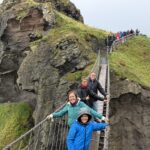
The highs/top outings during our trip were:

The lows (for me):

  • Belfast. I have to be honest, I struggled with this city, mainly because of the atmosphere created by the murals. Many of the tours focus on wall paintings about past conflicts, and the figures portrayed were involved in very violent events. Seeing them displayed so prominently, almost celebrated, and called ‘volunteers‘ felt unreal to me. In my mind, ‘volunteer‘ was being used as a synonym for people who committed acts I find deeply troubling. When I told my friends that my first step to improve the city would be to paint over all those walls, they couldn’t understand me at all.
    The strange thing is that the people were incredibly friendly. It was the only place where someone shared his whole life story with me while we waited for the bus, and the only place where asking for directions led a woman to start in Welsh and then switch instantly to English when she saw my face.
    Very warm people, but for me, the city itself felt heavy and depressing.
  • Very long rides, long times in the car. Lots of days we spend between 2 and 6 hours in the car. A lot and quite stressfull.
  • Spanish timetables. Eating late, like in Spain, is not the Irish way. Finding a place to eat after 22:00 was not a nice experience, and we ended up lots of times eating fastfood or chinese.
  • Last day. Stress. Wake up early, drive 3.5 hours to the airport to return the car, take a bus to the airport, check in, and take the plane. No breakfast, no lunch, only coffee, and after arriving take the bus home and walk for 15 minutes with 4 huge bags. Not the best way to end the holiday, thats for sure.

Ireland: 1 mistake

A waterfall, then a castle, and then a small surprise. The cottage we had booked turned out to be 200 km further away. Oof. Well, these things happen. We arrived late, but with a small BBQ it still turned into a nice evening.

The next morning we headed out early, towards a little beach. But soon the route started to look suspiciously familiar… The beach was only 5 km from the castle we had visited the day before. So another 200 km of driving. And after the beach, plus a few other sights in the area, another 200 km back.

In the end we clocked 600 km (and also 6 hours) that we could easily have avoided if I hadn’t trusted the AI so blindly. Unfortunately, I only realized that when it was already too late.

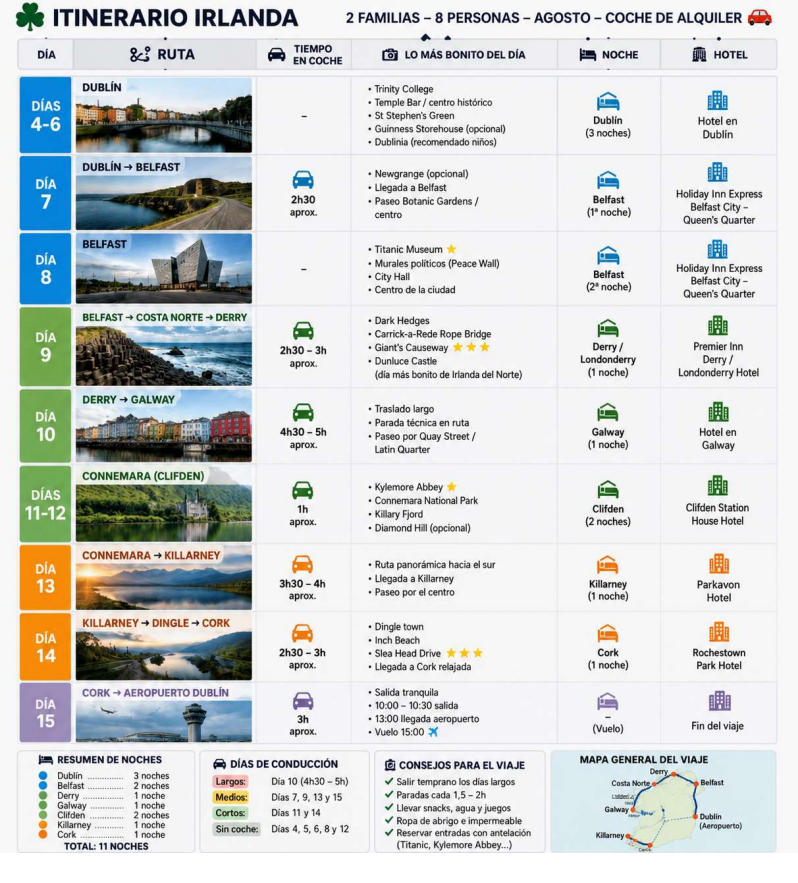
Ireland: The plan

We’re exploring Ireland for our family vacation. From the 6th to the 15th of August we plan to discover a new culture. We are going with some friends, and in total we will be a party of eight persons, so fun is guaranteed. Ana and Nuria make a very nice planning for the trip. I did notice we spend quite some time driving around, but they have thought about it, so it should be okay.
This is the plan that was devised. When we return I’ll post a travel evaluation.

Seeing and experiencing plenty of places is of course an important part of the holiday. So far, the plan looks perfect for discovering many different sides of Ireland. I also have my own wishes for this trip, and that’s to get a little taste of Irish life and I don’t think that’s difficult at all. Starting the day with a nice big breakfast, and ending it with a pint in the pub. That feels like the right way to experience Ireland.

Less is more – Digital hoarder

Since the previous century I have been saving my digital photos. My first camera was the Kodak DC220, a bulky 1‑megapixel device with an enormous battery consumption. After that came a Canon Digital Elph, a Canon Ixus, and eventually my current Canon Powershot G7X. Probably my last dedicated camera, because these days I take almost all my photos with my phone. I always have it with me, so taking a photo is much easier but it also means I think less about it, and a lot of digital clutter ends up in the mix.

A few times a year I add the photos from my camera and phone to my archive. That archive started small: maybe 30 or 40 photos per year. But taking photos has become so easy, and sharing or receiving photos so normal, that I now have years with more than 10,000 photos. Far too many, of course. Sometimes I even feel like a kind of digital hoarder: someone who fills their house with everything they can get their hands on, but digitally. Every little screenshot, every failed photo, every duplicate shot ends up somewhere in a folder. It piles up without me noticing, to the point where the archive feels more like a digital storage unit than a collection of memories. By deliberately pruning, I make the archive usable again, a collection I can browse without feeling overwhelmed, where the photos that remain actually say something about that year and about my/our life. That, to me, is the essence of selecting an archive.

That’s why I introduced a clear rule: about 100 photos per year. And for big events, a maximum of 100 photos per event. The focus is on photos with family and friends, supplemented with a few landscapes or nature shots that truly add something. It’s the same logic as my paper albums. I do look at those from time to time, precisely because they only contain the photos that matter.

100 photos per year, 26 years, plus a few major events. Still a substantial collection, but finally one I can view, cherish, and maintain. An archive that works as an archive again, and not as a digital basement full of forgotten files. A way to preserve memories without drowning in the sheer amount.

July ’26 – Rodriguez

This month I was the ‘Rodriguez’. In Spain the statement carries a mix of humor, resignation, and a tiny wink of freedom. It’s the classic situation where someone stays behind working while the rest of the family goes on vacation. After taking the kids to the Netherlands, I brought them to their mother for some weeks at the beach in Torrevieja. After a weekend I returned home to fulfill my obligations, and so I ended up de Rodriguez.

As the Rodriguez, there’s the routine of going to work every day. After that, it’s keeping the house in order, cleaning, cooking, washing clothes, drying, folding and storing, tidying up, take care of the pets and everything else that comes along. Ana even tried to give me an extra task: painting the entire house. Fortunately, I managed to diplomatically avoid that one. And if I do happen to find a bit of scarce free time, it usually goes into cleaning the car, dusting the shelves, reorganizing the kids’ toys, cleaning the windows, and so on.

With all these tasks, it’s unlikely I’ll have any time left for myself, but if it does happen, I might still squeeze in a bit of enjoyment: a movie, a series, some music, playing around with my laptop, some exercise, a walk in the woods, working on my game, experimenting with my blog, an outing with the guys, a bit of shopping, building a LEGO set… The small freedoms of a Rodriguez, hidden between the responsibilities.