
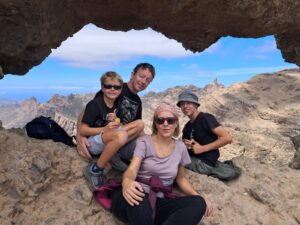
 It’s already been 20 years since I left. My emigration to Spain. I had already been living for a few months in Madrid (November, 2006) and luckily was able to more or less communicate in Spanish, and then suddenly a door opened for Ana in Gran Canaria. I was quickly convinced, and luckily I managed to convince Ana to just take the gamble. Together we went to Las Palmas, heading into the adventure.
The beginning was difficult for me. Sorting out papers, finding work, it was all not easy. I did find work quickly, but a truly stable situation it certainly wasn’t in those first few years. Ana had more luck and more stability, although in those first years she too had to hope for a new contract every month. I learned a lot this period. A new mentality, the language, the customs.
We started in a room near San Telmo. After that we moved to an apartment by Canteras. After a few years we upgraded to Ciudad Jardín. Our first son was born in Alcalá, and when we returned to our apartment felt like it was actually a bit too small. So we moved again, this time to Carvajal. We’re still here, now with two children, each with their own room. Things are going well for us.
We grew together and started a family. We had our ups and a few very big downs, but somehow we survived. In those 20 years we slowly built up our social network. We can still feel the lack of family nearby, but it also became easier to rely on friends.
Do you also want to take the leap and move to another country? Here are a few tips.
- The most important point: learn the language. As soon as you know even a little, start using it right away. We all make mistakes, and it’s the fastest way to learn something new. Making lots of mistakes is actually a very quick way to get a language under your belt.
- Train your patience. Many, many things become a lot more difficult when you’re a foreigner. Things that are easily arranged for a local often require you to go through every protocol and every barrier just to get something done. It’s usually not intentional, but when someone receives a request from a foreigner, they often become extremely focused on following the process perfectly, which they’re not used to, and it never works efficiently.
- Try to integrate into a local group. Take a course, sign up for a local excursion, or join a local sports club.
 We visited
 On the third day we went to the island of La Graciosa, which we had already seen from the viewpoint on our first day. A half-hour boat ride took us there. We bought some sandwiches and rented bikes for a long ride across the island. Getting lost was impossible: there’s only one clear route. At one of the beaches, Alex and I found some salt. It looked surprisingly clean, so I took a little with me to experiment with later. We returned on the last boat of the day and headed back to the villa.
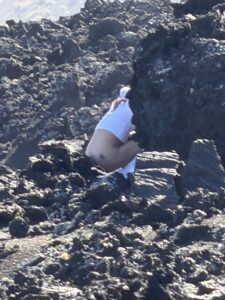 The guy went on to manage traffic, and a few minutes later my son called me. He had taken a picture with his phone and was zooming and scrolling. Something was there. A piece of pink in the dark black volcanic surroundings. I took a picture myself, to get a better look, and there it was. A girl had wondered a few hunderd meters into the vulcanic surrounding to hunker down and leave a poop. A typical case of when you have to go, you have to go.
 Miguel, Alex’s godfather and Alan’s pan-godfather, has a conference where he was invited to give a talk. He’s attended conferences all over the world before, but this time it’s in
 Oh no, a big storm was on its way… Emilia. Many public and semi-public activities were cancelled. The forecast for Saturday was high waves (up to 12 meters!) and strong winds. Not the best situation for a boat trip to Tenerife, but so be it. We had the first boat on Saturday. Also the last, because after that all trips were cancelled. It was an interesting crossing.
 Every year, Sinterklaas visits the Hotel Barbacan in Maspalomas, in the south of the island. The hotel is a favorite destination for many Dutch guests, and maybe that is why they have fully embraced Dutch traditions. Sinterklaas comes by for all the Dutch children staying at the hotel, but Dutch residents of Gran Canaria are also welcome, and sometimes even receive a personal invitation.

 A chuletón is a large ribeye steak with the bone still in. These steaks are massive—over a kilo—and meant to be shared. In Spain, going out for a chuletón is much more than just dining out. It’s a social event, something to enjoy together with friends. Since the
 About once a month, we follow the same ritual. We leave from the square near where we all live and drive to the restaurant. We start with a beer and choose a huge cut of meat, anywhere between one and two kilos. The steak is prepared, and then served to us with a hot stone so we can do the final touches ourselves. Naturally, it’s accompanied by a good bottle of red wine. Then it’s time to eat and above all, to enjoy. We always go on Thursdays, because there’s always space and we don’t need to book or wait.
 The English used to send criminals and unwanted individuals to Australia. The Russians sent their troublesome people to Siberia. Spain also had its own place for unwanted residents and they were given a one-way ticket to Fuerteventura. It’s quite understandable that Fuerteventura was chosen as a destination for undesirable individuals. The entire island consists mainly of sand and rocks, with only the occasional plant and a clear lack of water. It’s bone dry everywhere.
 Miguel told me this wild, but true story about his day during
 Well, my