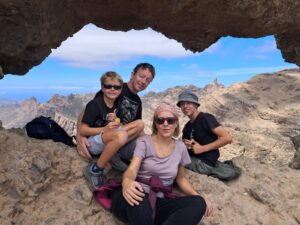
20 years in Spain

It’s already been 20 years since I left. My emigration to Spain. I had already been living for a few months in Madrid (November, 2006) and luckily was able to more or less communicate in Spanish, and then suddenly a door opened for Ana in Gran Canaria. I was quickly convinced, and luckily I managed to convince Ana to just take the gamble. Together we went to Las Palmas, heading into the adventure.

The beginning was difficult for me. Sorting out papers, finding work, it was all not easy. I did find work quickly, but a truly stable situation it certainly wasn’t in those first few years. Ana had more luck and more stability, although in those first years she too had to hope for a new contract every month. I learned a lot this period. A new mentality, the language, the customs.

We started in a room near San Telmo. After that we moved to an apartment by Canteras. After a few years we upgraded to Ciudad Jardín. Our first son was born in Alcalá, and when we returned to our apartment felt like it was actually a bit too small. So we moved again, this time to Carvajal. We’re still here, now with two children, each with their own room. Things are going well for us.

We grew together and started a family. We had our ups and a few very big downs, but somehow we survived. In those 20 years we slowly built up our social network. We can still feel the lack of family nearby, but it also became easier to rely on friends.

Do you also want to take the leap and move to another country? Here are a few tips.

  • The most important point: learn the language. As soon as you know even a little, start using it right away. We all make mistakes, and it’s the fastest way to learn something new. Making lots of mistakes is actually a very quick way to get a language under your belt.
  • Train your patience. Many, many things become a lot more difficult when you’re a foreigner. Things that are easily arranged for a local often require you to go through every protocol and every barrier just to get something done. It’s usually not intentional, but when someone receives a request from a foreigner, they often become extremely focused on following the process perfectly, which they’re not used to, and it never works efficiently.
  • Try to integrate into a local group. Take a course, sign up for a local excursion, or join a local sports club.

GTA6 preparations

GTA6!I don’t really play games anymore, at least not the big ones. A few times a year I might play some Minecraft with the kids, but that’s about it. Our PlayStation is mostly for them (as long as they ask for permission first). I still play the occasional mobile game, but the real stuff? I haven’t had time for that in many years.
Yet I went ahead and did it: I pre-ordered GTA6. It is probably completely unsuitable for the kids, but I wanted to find out for myself whether all the hype around the game is justified. A long time ago I played quite a lot of GTA1, and I was curious to see what the series has become all these years later.

A few months ago I installed a new SSD in our PlayStation because it was completely filled with games. Around the same time I pre-ordered GTA6. There is no disc this time, so there is no need to visit a shop, but it does require some patience. The option to download the game became available today. Now the download is complete, and yet I still have to wait until next week before I can actually start the game.

Reverse christmas box

Most people receive a Christmas gift box during the holiday season, but this year we’re doing things differently: we’re giving one instead.
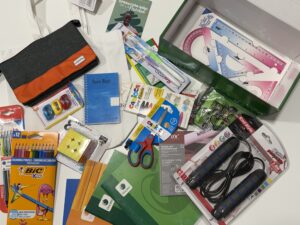
We will have to buy the contents of the box ourselfs, which will probably cost around 30 EUR and for just 10 EUR we were able to send the Christmas box (a shoebox filled with useful items) to a less affluent country. We selected a recipient between the ages of 10 and 14 so that our children could act as experts when choosing appropriate gifts. The shoebox will be sent to Equatorial Guinea, North Africa, Romania, or Ukraine.

We picked out the contents of our box together: a toy, school supplies, and a few useful items. No food, no liquids, and no toys related to war or violence.

Costs of the stuff we send: Around 30 euros.
Sending the box: 10 EUR
At least one kid happy: Priceless.

The contents of our box… It turned out to be a very nice box. A Rubik’s cube, jump rope, pencil case, small bag, colored pencils, glow-in-the-dark colored pencils, 4 notebooks, a drawing pad, erasers, pencil sharpeners, a pair of scissors, a set of rulers, a wallet, and toothbrushes. A set oriented towards school, but still with some fun items in it. Alex and I also included a note with a simple text in Spanish and English. ‘These things are for you. We hope you are happy with them. Greetings, Alan, Alex, Ana and Adrie’.

October ’26

Daily routines run at full speed again. School, work, the small habits that shape the weeks. Once again some unexpected stuff happened, like an enormous bank saldo (sadly only lasting very shortly). This little error gave me a little boost to investigate crypto and coins a little bit more, which resulted in my own cryptocurrency.

We went to Agualand during one of the weekends, where I spend hours walking/running up to all the slides and sliding down with mostly Alan, and a few times with Alex. Alex spend most of his time in the park with his friends. Ana spend most of her time talking to other girls from our group.

Alan had a winning streak in the start of this football season. They started with a couple of massive wins. A good start, and now we’ll see if they can keep the lead.

I’ve let MycoSweep rest for a while. Taking a break and focusing my thoughts elsewhere helps me return with a fresh perspective and continue in the right direction later on.

My in-between project was to give the old Pokerbingo game a bit of a refresh and publish it on my blog. A long time ago, I removed the game because of potential legal concerns, but thanks to AI, I now know I have nothing to worry about.

Another project closer to home was a bit of household rearranging. Alan swapped rooms with Ana and me. A month full of routine, but still with a few remarkable events.

My own crypto: How does it work?

The only thing you need is an email address. That’s all. There is very little security, only the bare essentials. Other people can see how many coins you have if they know your email address.

You can send or request coins using the email address of the person you want to trade with. You can even send coins to people who do not yet have an account. Every transaction results in a confirmation email being sent to you, which you must approve before the transfer is completed. This helps ensure that nobody can spend coins that do not belong to them.

My first attempt of adding value
I have decided to give my crypto a value based on time. One crypto coin represents one minute. Fifteen coins equal fifteen minutes. If someone does something for me that takes five minutes, I give them five coins.

A cup of coffee, fully prepared and brought to the table: 5 minutes. A massage: 10 minutes. Cleaning a room: 20 minutes?

In our family these minutes can then be spent on activities that I would normally limit, such as using a tablet, a phone, or the PlayStation.

My own crypto: Value?

How much does it cost?
Crypto represents value, just as we discussed before. That value is based on trust, but part of it is also represented by costs. If hundreds of computers are used to store and verify transactions, every transaction comes with a cost. There are server costs, costs associated with keeping the ecosystem secure and up to date, and costs related to government regulations and compliance requirements.

In my case, the costs are much lower. I already had the basic infrastructure in place, and all transactions are stored on a single server. My trust in the currency is high, but for the rest of the world that trust still has to be earned, so for now I will realistically value it at zero.

The result is a coin that is free to obtain and free to exchange. Even better, you can receive 10 free coins every 24 hours!

🚰 Daily Faucet (+10 $L365)

Enter your email to claim your free daily allowance.

What is it worth?
Value is complicated. It is usually based on how scarce something is and how useful it is to you. Some cryptocurrencies are expensive because they have gradually gained enough trust for people to consider them valuable. Every day, new cryptocurrencies appear from sources that people have never heard of, and these often lose trust (and therefore value) very quickly.

What remains is how you personally feel about the cryptocurrency. Is it useful in some way, and can you make use of it? For me, there is a cost involved. I pay for the servers, and I invest time in software development. Even so, I feel that I can find practical uses for this cryptocurrency.

My own crypto: L365

After learning a little bit about cryptocurrencies and blockchains, I decided to create my own experimental coin: L365.

Unlike Bitcoin, L365 does not use a blockchain. For now it simply uses a database on my website to keep track of balances and transactions.

Users can receive 10 coins for free each day, as long as the supply lasts. Users can send coins to each other, collect them, and spend them on future features and experiments.

Like any currency, the value of L365 depends on whether people find it useful and are willing to use it. Because L365 is stored in a database that I manage, trust also plays an important role. Users must trust that I maintain the system fairly, keep accurate records, and do not create or remove coins without being transparent about it.

Is L365 a real cryptocurrency? Not quite. Is it a way to explore many of the same ideas behind money, trust, ownership, and value? Absolutely.

My own crypto: Blockchain?

Its complicated. If you dont have a bank that manages all the money, you really need to have something transparent. Something everyone can understand. A list of all the coins there are, and how they have moved around from the beginning. A list stored on lots and lots of different systems. This is what some person called the blockchain. A blockchain is essentially a shared ledger. Thousands of computers can keep a copy of the same transaction history. Whenever coins move from one person to another, the network updates the ledger.

The advantage is that no single person owns or controls the database. The network itself verifies the transactions.

For our project we do not need thousands of computers. We can start with a single database on a single server. It will not be decentralized, but it will allow us to explore many of the same ideas.

In this experiment, I effectively act as the central bank. I decide how many coins exist, I maintain the database, and I can verify transactions. This means that trust in the coin is based not only on the software, but also on the trust you place in me.

My own crypto: What is it?

Step one to making my own crypto is easy. I need to understand what it really is, together with understanding what it is not. Money is something people agree has value. In the distant past, coins were often made from valuable metals such as gold or silver. Later, paper money became popular because it was easier to carry. At first, some paper notes could be exchanged for a fixed amount of gold held by a bank.

Over time, most countries abandoned the link between money and gold. Today, the euro and most other currencies are valuable because people trust that others will accept them in exchange for goods and services.

Cryptocurrencies work differently. They are digital money that exists only on computers. There is no central bank printing them and no vault full of gold supporting them. Instead, cryptocurrencies rely on a network of computers that maintain a shared record of ownership, known as a blockchain. This record makes it possible to transfer coins directly between users without needing a bank to keep track of balances.

Like traditional money, cryptocurrencies have value because people are willing to accept, trade, and use them. Whether that value will rise or fall depends entirely on supply, demand, confidence, and usefulness.

In the next post, we’ll look at the blockchain: the technology that allows cryptocurrencies to work without a central bank.

Guiniguada – Batan

Last week Alan didn’t play. There are to many kids in his team, so for the offical games some kids will be excluded. We did enjoy the free weekend. This weekend Alan did get to play against an almost all girl team. It was a nice match which we won 3 – 2 with a nice assist by Alan.

Results

Date Home Result Visitors
24 Okt, 10:30 Guiniguada 2 – 3 Batan B
16 Okt, 18:00 Batan B
(without Alan)
we won no idea
9 Okt, 18:00 Batan B 14 – 2 Las Torres
3 Okt, 09:00 Alcotan 1 – 10 Batan B